Hair Transplant Clinic in Zirakpur: How to Choose the Right Treatment for Hair Loss

Hair loss can affect both men and women and may occur because of genetics, hormonal changes, nutritional deficiencies, stress, medical conditions, or progressive hair thinning. While temporary hair fall may improve after addressing its underlying cause, permanent hair loss often requires a more targeted approach. Therefore, choosing the right Hair Transplant Clinic in Zirakpur is an important step for anyone considering long-term hair restoration.
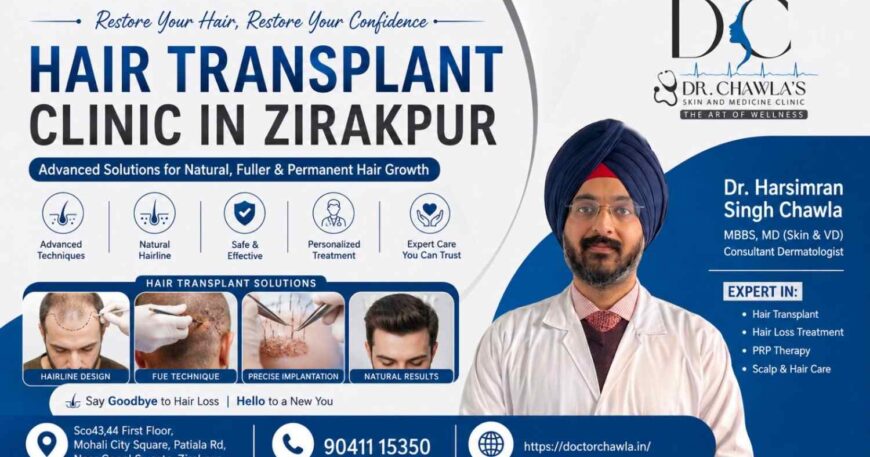
At Chawla Skin and Medicine Clinic, Dr. Harsimran Singh Chawla focuses on evaluating the cause and pattern of hair loss before recommending a suitable treatment. Depending on the condition, options may range from medical management and supportive therapies to hair transplantation.
Why Choosing the Right Hair Transplant Clinic in Zirakpur Matters
Hair transplantation is not simply about moving hair from one area to another. Instead, it requires careful assessment, treatment planning, appropriate graft placement, and consideration of the patient’s future pattern of hair loss.
When selecting a clinic, consider the following factors:
- Proper evaluation of the scalp and hair-loss pattern
- Clear explanation of available treatment options
- Realistic discussion about expected outcomes
- Focus on natural-looking hairline design
- Appropriate hygiene and clinical protocols
- Detailed guidance for recovery and aftercare
- Individualized treatment rather than a one-size-fits-all approach
Most importantly, patients should understand why a particular treatment is being recommended before proceeding.
Start With a Proper Hair Loss Assessment
Before choosing any hair restoration procedure, it is essential to identify the cause of hair loss. Not everyone experiencing hair fall requires a transplant.
A clinical assessment may consider:
- Pattern and severity of hair loss
- Family history of baldness
- Condition of the scalp
- Hair density and thickness
- Availability and quality of donor hair
- Age and progression of hair loss
- Previous treatments
- General health and medical history
For example, active hair shedding caused by nutritional deficiencies, stress, or certain medical conditions may require management of the underlying issue first. On the other hand, patients with established pattern hair loss and a suitable donor area may be considered for transplantation.
Hair Transplant Treatments: Which Technique May Be Suitable?
Different hair transplant approaches are available. However, the right option depends on individual requirements, donor availability, hair characteristics, and the extent of hair loss.
1. FUE Hair Transplant
Follicular Unit Extraction (FUE) is a commonly used hair transplant technique. During FUE, individual follicular units are extracted from the donor area, usually from the back or sides of the scalp. These grafts are then implanted into areas affected by hair loss.
Potential advantages include:
- Individual graft extraction
- No long linear donor scar
- Relatively small extraction sites
- Suitable for different patterns of hair loss
- Allows strategic placement of individual grafts
However, suitability should always be assessed individually because donor density and the number of grafts required vary from person to person.
2. FUT Hair Transplant
Follicular Unit Transplantation (FUT) involves removing a thin strip of scalp from the donor region. Individual follicular units are then separated and transplanted into the recipient area.
FUT may be considered in selected cases where a larger number of grafts is required. Nevertheless, it leaves a linear scar in the donor region, and therefore the advantages and limitations should be discussed before treatment.
3. Combination Approach
In certain cases, a combination of techniques may be considered depending on the extent of hair loss and donor availability. However, the treatment plan should be determined only after evaluating the patient’s scalp and long-term hair restoration needs.
Look for Natural Hairline Planning
One of the most important aspects of a successful-looking hair transplant is appropriate hairline design. An excessively low, straight, or unnatural hairline can make the outcome appear artificial.
Therefore, hairline planning should consider:
- Facial proportions
- Existing hairline
- Patient’s age
- Direction of natural hair growth
- Future progression of hair loss
- Available donor grafts
Moreover, transplanted grafts should be positioned at suitable angles and directions to blend with existing hair.
Evaluate the Donor Area Carefully
The donor area plays a major role in determining whether someone is a suitable candidate for a hair transplant. Since donor follicles are limited, they need to be used carefully.
Before transplantation, the clinic should assess:
- Donor hair density
- Hair shaft thickness
- Scalp condition
- Number of grafts potentially available
- Previous donor-area procedures
- Expected future hair loss
Consequently, responsible donor management is particularly important for younger patients who may experience further hair loss over time.
Consider Non-Surgical Hair Loss Treatments Too
Choosing a Hair Transplant Clinic in Zirakpur does not automatically mean that surgery will be the first recommendation. Some patients may benefit from non-surgical management, either independently or alongside a transplant.
Depending on the diagnosis, a clinician may discuss options such as:
- Evidence-based medical treatment where clinically appropriate
- Nutritional assessment when deficiencies are suspected
- Scalp and hair-care recommendations
- PRP (Platelet-Rich Plasma) therapy in selected patients
- Other supportive hair restoration procedures where appropriate
Importantly, treatment results vary among individuals, and no therapy should be presented as a guaranteed solution.
Why Consultation and Realistic Expectations Are Important
Hair transplantation redistributes existing follicles; it does not create an unlimited supply of new hair. Therefore, realistic expectations are essential.
During consultation, ask about:
- Whether you are a suitable candidate
- Recommended technique
- Estimated graft requirements
- Donor-area limitations
- Expected recovery
- When transplanted hair may begin growing
- Whether additional hair-loss management may be required
- Possibility of future treatment sessions
Transplanted follicles generally require time to enter a normal growth cycle. Therefore, visible improvement is gradual rather than immediate, and final outcomes can take several months.
Hair Loss Consultation at Chawla Skin and Medicine Clinic
At Chawla Skin and Medicine Clinic, Dr. Harsimran Singh Chawla provides consultation for patients experiencing hair fall, thinning, and different patterns of hair loss. The approach begins with understanding the underlying condition and assessing whether medical management, supportive hair therapies, or hair transplantation may be appropriate.
Rather than selecting a treatment based only on advertisements or graft numbers, patients should focus on diagnosis, suitability, safety, donor management, and realistic expectations.
How to Choose the Right Hair Transplant Clinic in Zirakpur
Before making your decision, use the following checklist:
- Check the consultation process: A proper evaluation should happen before a treatment plan is finalized.
- Ask about treatment options: Understand why a particular hair transplant technique is being recommended.
- Discuss donor availability: Donor hair is limited and should be planned carefully.
- Understand hairline design: The planned hairline should complement your facial proportions and age.
- Ask about recovery: Get clear instructions about washing, scalp care, physical activity, and follow-up.
- Set realistic expectations: Be cautious of promises of guaranteed density or instant results.
- Discuss long-term hair loss: Existing non-transplanted hair may continue to thin, so future management should also be considered.
Conclusion
Frequently Asked Questions
1. Who is a suitable candidate for a hair transplant?
People with stable or established pattern hair loss, sufficient healthy donor hair, and realistic expectations may be considered suitable candidates. However, a scalp and hair-loss assessment is necessary before making a decision.
2. How long does it take to see results after a hair transplant?
Hair transplant results develop gradually. Initial shedding of transplanted hairs can occur, followed by new growth over the following months. The timeline and final outcome can vary depending on individual hair-growth cycles and other factors.
3. Is a hair transplant a permanent treatment for hair loss?
Transplanted follicles taken from suitable donor areas are generally intended to provide long-lasting growth. However, existing non-transplanted hair can continue to thin over time. Therefore, long-term hair-loss management and follow-up may still be recommended.